












Can I Get a Gold Loan From Cholamandalam Without Income Proof?
 Cholamandalam
 01 Oct 2026
 7 Min Read
 Gold Loan
 45 Reads
- Introduction
- Does a Gold Loan Require Income Proof?
- How Does Secured Lending Work?
- What Are the Eligibility Requirements?
- What Documents Are Required?
- How Is Gold Valued?
- Benefits for Salaried, Self-Employed and Farmers
- Conclusion
- Frequently Asked Questions
Introduction
Life can bring financial requirements at any time, whether for business expansion, a child's education, home renovation, a major purchase or a temporary cash requirement. If you own gold jewellery, you may be able to use it as collateral to access funds without giving up ownership of the gold.
A gold loan allows you to pledge eligible gold jewellery as security and borrow against its assessed value. Once the loan is fully repaid, the pledged gold is returned to you.
Does a Gold Loan Require Income Proof?
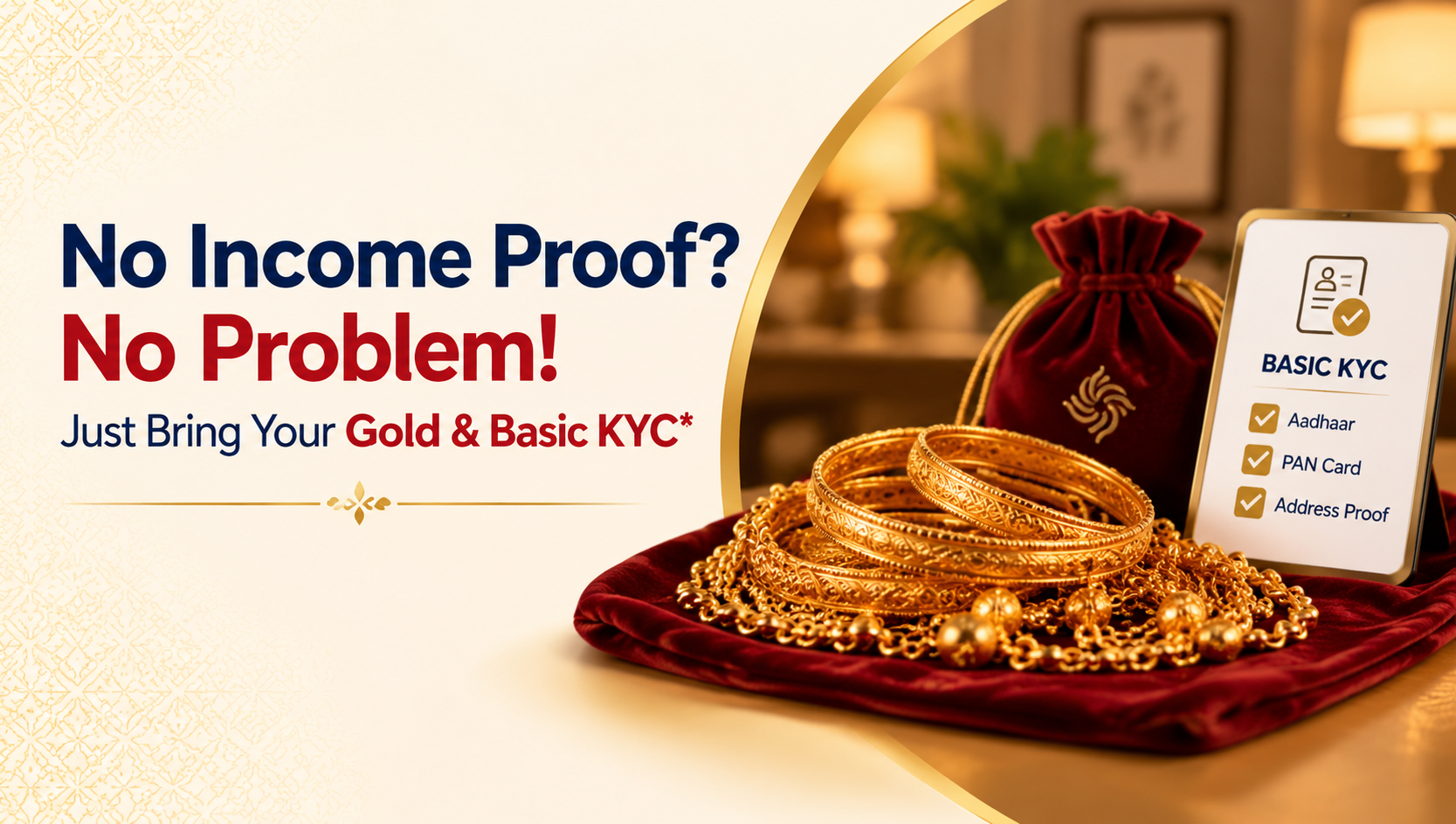
Generally, no. Unlike many traditional loans, a gold loan typically does not require income proof or Income Tax Returns (ITRs) because the loan is secured against gold.
This means salaried employees, self-employed individuals, business owners, farmers, homemakers and people without a fixed monthly income may be able to apply, subject to the lender's eligibility criteria.
The loan amount is primarily determined by the value of the pledged gold and the applicable Loan-to-Value (LTV) ratio rather than solely by your salary or regular income.
How Does Secured Lending Work?
Collateral Offsets Risk
Unlike unsecured personal loans, where lenders may evaluate salary slips, Form 16, ITRs and other income-related documents, a gold loan is backed by eligible gold jewellery provided as collateral.
The gold serves as security for the loan, which means the lending decision can focus significantly on the value and quality of the collateral.
Loan-to-Value (LTV) Safeguards
The Loan-to-Value (LTV) ratio determines the maximum amount that can be sanctioned against the assessed value of the gold. LTV limits provide a safety margin between the value of the collateral and the amount borrowed.
Gold loan LTV limits are subject to applicable regulatory guidelines and the lender's policies.
Asset-Based Evaluation
Gold loans primarily evaluate the pledged gold based on factors such as its purity, quality, weight and assessed value rather than relying only on the borrower's income profile.
This asset-based approach can make the process more straightforward for borrowers who may not have conventional income documents.
What Are the Eligibility Requirements?
The eligibility requirements mentioned in the source include:
- Indian citizenship.
- Age generally between 21 and 75 years, depending on the lender.
- Eligible gold jewellery such as chains, bangles, rings and necklaces.
- The source also states that gold coins up to 50 grams may be allowed, while gold bars are not acceptable.
- Gold purity generally between 18 and 22 carats.
- No minimum CIBIL score requirement is specified for the gold loan.
What Documents Are Required?
Since a gold loan is secured against gold, the documentation can be simpler than that required for some conventional loans. The source lists the following documents:
- Basic KYC documents
- Identity proof: Aadhaar, PAN, Voter ID, Passport or Driving Licence.
- Address proof: Recent utility bill, post-paid broadband/mobile bill or registered rental/lease agreement.
- Passport-size photograph: If required.
Income documents such as salary slips, Form 16 or ITRs are generally not required for a standard gold loan. However, gold loans taken for income-generation purposes may require ITRs, GST returns or other business-related documents, depending on the applicable requirements.
How Is Gold Valued?
The value of the gold is assessed before the loan amount is determined. The source describes the valuation process as follows:
- Trained personnel or an authorised appraiser assess the purity of the gold.
- The net weight of the gold is calculated after excluding gems, stones and other embedded materials.
- The value is determined using applicable benchmark rates, including those set by the India Bullion and Jewellers Association Ltd. (IBJA), as mentioned in the source.
- The valuation process may take approximately 15–20 minutes.
The assessed gold value is then used along with the applicable LTV ratio to determine the amount that may be sanctioned.
What Are the Benefits for Salaried, Self-Employed and Farmers?
A gold loan can be relevant to borrowers with different income profiles because the primary security is the pledged gold.
| Feature | Salaried Employees | Self-Employed / Traders | Farmers & Agri-Workers |
|---|---|---|---|
| Primary Use Case | Emergencies, debt consolidation and education fees | Working capital, bulk inventory and payroll | Seeds, fertilisers, tractor repairs and harvest costs |
| Biggest Paperwork Hurdle Solved | No current payslips or Form 16 | Need audited ITR, P&L, or GST returns | No requirement for land titles or crop-yield proofs in the standard process described |
| Ideal Repayment Structure | Monthly EMIs or monthly interest servicing | Short-term tenure with flexible part-payments | Bullet repayment |
| Core Impact | Helps protect long-term investments and credit profile | Helps maintain cash flow and business agility | Helps support timely crop cycles without relying on informal borrowing |
Note: Gold Loans for income-generation purposes may require ITRs, GST returns or other business-related documents. Eligible borrowers may also benefit from a higher LTV ratio, subject to applicable guidelines.
Salaried Employees
Salaried individuals may use a gold loan to meet financial requirements without necessarily breaking investments such as recurring deposits, fixed deposits or SIPs. It may also be useful when someone has recently changed jobs or is unable to provide documents such as Form 16 or ITRs, subject to applicable eligibility requirements.
Self-Employed Individuals and Traders
Shopkeepers, traders, freelancers and small entrepreneurs may use gold loans to meet working capital requirements, make upfront vendor payments or manage short-term business needs.
For applicable personal-use gold loans, the source notes that borrowers may not need the same type of audited financial statements that can be required for other forms of borrowing. However, income-generation purposes may require additional business-related documents.
Farmers
Farmers often have seasonal cash-flow cycles. Depending on the applicable gold loan scheme, repayment structures such as bullet repayment or interest-only servicing may help align repayment with the farming cycle.
The funds may be used for requirements such as seeds, fertilisers, diesel, equipment or repairs. The source also highlights regulated institutional credit as an alternative to informal borrowing.
Conclusion
The key difference between a conventional income-based loan and a gold loan is the basis on which the borrowing is evaluated. A gold loan is primarily secured against the value of eligible pledged gold, while many conventional loans rely more heavily on income documents and credit profile.
This can make a gold loan a potential financing option for people who may not have conventional income documentation. At Chola, the source highlights rapid processing, security, transparent valuation and different gold loan schemes to support borrowers with varied financial requirements.
To know more about Chola Gold Loan, visit:
Frequently Asked Questions
1. Can I get a gold loan without a high CIBIL score?
Yes, the source states that a high CIBIL score is not required for the gold loan because the loan is secured against eligible gold. This may allow borrowers with limited or no prior credit history to apply, subject to the lender's eligibility criteria.
2. Can homemakers or students apply for a gold loan?
Yes, homemakers and students may apply if they meet the applicable eligibility requirements, including the stated age range, ownership of eligible gold ornaments and basic KYC requirements such as Aadhaar and PAN.
3. Can I get a gold loan against gold coins or raw bullion?
The source specifies that eligible jewellery is generally accepted and states that gold coins up to 50 grams may be allowed, while also noting restrictions on raw bars, bullion and loose coins under standard schemes. Acceptance can therefore depend on the applicable scheme and lender requirements.
4. How quickly can a gold loan be approved?
The source states that approval and disbursal can take around 30 minutes, depending on the valuation and completion of the applicable process. Since income verification is generally not required for a standard gold loan, this can reduce documentation-related delays.
5. How is my gold secured after I pledge it?
The pledged gold is weighed and sealed in tamper-evident packaging in the borrower's presence. The source states that Chola stores pledged gold in high-security, insured branch vaults with multi-layer physical and digital security measures.
 Previous Blog
About the Author
 Cholamandalam
Latest Blogs from this Author
Blogs you might also like


 06 Aug 2024
7 Min Read
Cholamandalam
06 Aug 2024
7 Min Read
Cholamandalam
 01 Nov 2024
7 Min Read
Cholamandalam
01 Nov 2024
7 Min Read
Cholamandalam
 01 Jan 2025
7 Min Read
Cholamandalam
01 Jan 2025
7 Min Read
Cholamandalam
 02 Jan 2025
7 Min Read
Cholamandalam
02 Jan 2025
7 Min Read
Cholamandalam
 08 Jan 2025
7 Min Read
Cholamandalam
08 Jan 2025
7 Min Read
Cholamandalam
Connect with us on


Quick Financial Support