












What Are the Eligibility Requirements for a Loan Against Property?
 Cholamandalam
 06 Oct 2026
 5 Min Read
 Loan Against Property
 33 Reads
- What is a Loan Against Property (LAP)?
- What are the eligibility requirements for a loan against property?
- How does your credit score impact loan against property eligibility?
- What types of properties are eligible and how is valuation done?
- What are the specific documentation and business vintage requirements?
- What are the common reasons for loan rejection?
- How can you improve your eligibility for a loan against property?
Table of Contents
What is a Loan Against Property (LAP)?
A Loan Against Property (LAP) is a secured loan where residential or commercial real estate is used as collateral. The lender evaluates the property and offers a percentage of its value as the loan amount. LAP can be used for purposes such as business expansion, higher education, medical emergencies and other financial requirements.
Since the loan is secured against the property, the borrower retains ownership and possession of the property and can continue to use it. The lender holds the title deeds until the loan is fully repaid.
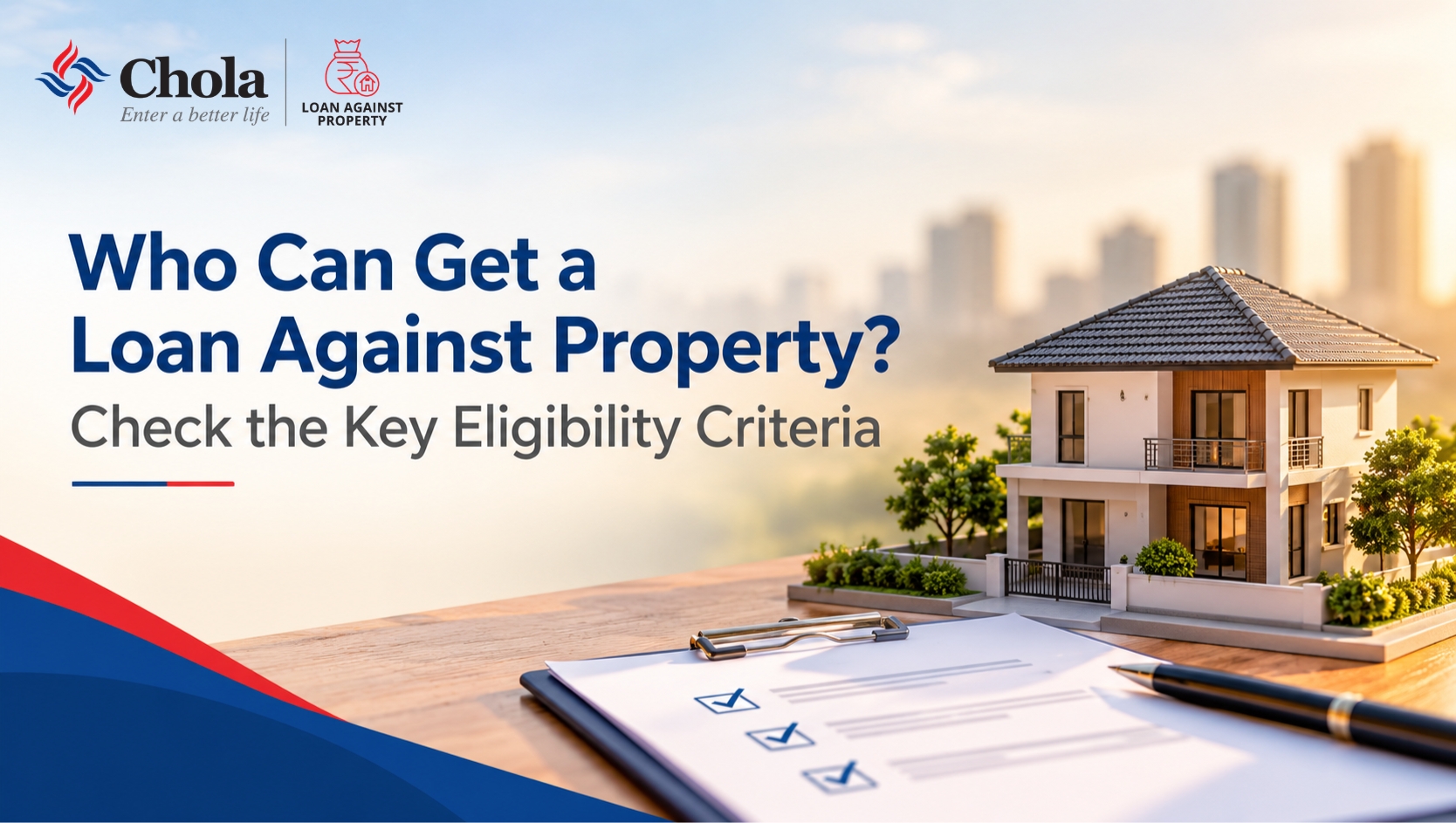
What are the eligibility requirements for a loan against property?
Loan Against Property eligibility depends on several factors, including the applicant's age, income stability, credit history, property ownership and the property's value and legal status.
Age Requirements
The minimum age for a Loan Against Property is generally 18 to 25 years, with some lenders requiring applicants to be at least 24 years old.
The maximum age may vary depending on the applicant's employment type. Salaried applicants may generally be eligible up to retirement age, while other applicants may have a maximum age of up to 90 years at loan maturity.
Income Stability
Lenders assess the applicant's income and repayment capacity. Salaried applicants may need to provide payslips and employment proof, while self-employed applicants may need to provide audited financial statements and tax returns.
For salaried applicants, FOIR is typically capped at around 60%. For self-employed applicants, FOIR may be around 65% to 70% of net profit.
Property Ownership and Title
The property offered as collateral should have a clear and undisputed title. The lender conducts legal and technical verification of the property before approving the loan.
Property valuation also plays an important role in determining the loan amount and approval.
Credit History
A strong credit history can improve the chances of loan approval. Lenders consider the applicant's credit score and repayment history while assessing creditworthiness.
How does your credit score impact loan against property eligibility?
Your credit score is an important factor in Loan Against Property eligibility. A higher credit score generally indicates a stronger repayment history and can improve the probability of approval and access to better loan terms.
| Credit Score Range | Impact on Loan Approval and Terms |
|---|---|
| Below 650 | High risk of rejection. Approval is rare and requires exceptional income and property value. |
| 650 to 699 | Possible approval. Some lenders accept scores as low as 650 if the applicant has strong income and clean property documents. |
| 700 to 749 | Good probability of approval. A score of 700 is considered a practical minimum for standard terms. |
| 750 and above | Excellent probability of approval. Scores of 750+ can unlock the best interest rates and higher loan limits. |
A credit score of 700 is considered a practical minimum for a Loan Against Property, while a score of 750 or above indicates a highly creditworthy applicant.
Applicants can improve their eligibility by reviewing their credit report, correcting errors, paying outstanding debts and maintaining a strong repayment history.
What types of properties are eligible and how is valuation done?
Residential and commercial properties may be accepted as collateral for a Loan Against Property. The property may be owned by the applicant or, in some cases, by close relatives.
The property's current market or appraised value is considered rather than its original purchase price. A valuer assesses factors such as location, construction quality, age, amenities and surrounding infrastructure.
The distress value of a property may be approximately 80% to 90% of its market value.
| Property Type | Typical LTV |
|---|---|
| Residential | 65%–70% or 60%–70% |
| Commercial | 55%–65% or 40%–60% |
The Loan-to-Value (LTV) ratio can be calculated using the following formula:
LTV = Loan Amount / Current Market Value of Property × 100
Residential properties may be used as collateral by the applicant or close family members, while commercial properties may be used for business or investment purposes. The property's current market value and physical inspection are considered during valuation, and different LTV levels may apply depending on the property type.
What are the specific documentation and business vintage requirements?
Lenders generally assess identity, property ownership and income stability before approving a Loan Against Property.
For self-employed applicants, business continuity or business vintage is also considered. Applicants may generally need to demonstrate 2 to 3 years of business continuity. Some lenders may require 3 years in the same business or profession.
Commonly Required Documents
- Two years of Income Tax Returns (ITR)
- Profit and Loss statements
- Balance sheets
- Financial statements signed by a Chartered Accountant
- Bank statements
- Clear property title documents
- Proof of business continuity
Self-employed applicants may generally need to show 2 years of current business continuity and 3 years of total business continuity. Lenders may also prefer financial records covering the previous two years.
What are the common reasons for loan rejection?
A Loan Against Property application may be rejected for several reasons related to the applicant's financial profile, property or documentation.
- Low credit score or previous defaults
- Incomplete property documents or property disputes
- Property located in restricted zones
- Poor construction quality or an old building
- Low property valuation compared with the requested loan amount
- High existing debt or poor debt-to-income ratio
- Inconsistent business revenue
- Insufficient business vintage
How can you improve your eligibility for a loan against property?
Applicants can take several steps to improve their Loan Against Property eligibility and strengthen their application.
- Improve your credit score and maintain a strong repayment history.
- Pay down existing debt to improve repayment capacity.
- Keep property ownership and title documents updated.
- Add a co-applicant where appropriate.
- Compile complete and consistent financial records.
- Consider an independent property valuation.
A credit score of 750 or above may support favourable rates and tenures. Standard LTV for many lenders is generally around 50% to 70%.
 Previous Blog
About the Author
 Cholamandalam
Latest Blogs from this Author
Blogs you might also like


 06 Aug 2024
5 Min Read
Cholamandalam
06 Aug 2024
5 Min Read
Cholamandalam
 01 Nov 2024
5 Min Read
Cholamandalam
01 Nov 2024
5 Min Read
Cholamandalam
 01 Jan 2025
5 Min Read
Cholamandalam
01 Jan 2025
5 Min Read
Cholamandalam
 02 Jan 2025
5 Min Read
Cholamandalam
02 Jan 2025
5 Min Read
Cholamandalam
 08 Jan 2025
5 Min Read
Cholamandalam
08 Jan 2025
5 Min Read
Cholamandalam
Connect with us on


Quick Financial Support